
AI and search
Website Best Practices for LLM Discovery
What business leaders need to know about showing up when AI does the searching
Read article
An agent that compares prices, fills a cart or places an order needs a different permission for each. What merchants should verify before an agent buys, and how to start with one buying journey.
 Tom GaydosFounder and principal, On-Call CMO

An AI agent looking at your catalog might be comparing prices for a shopper, filling a cart for approval, or placing an order under instructions given earlier. Those are different jobs, and the permission needed for one doesn’t automatically cover the others.
That leaves merchants to decide what an agent may do on their site and what evidence they need before letting it do more. Some systems already connect a verified agent to a buyer’s approved instructions. Operators need to understand where those checks work across their own systems, and where they still need limits or human approval. [1]
For system integrators and consultants, there’s practical work in helping a merchant make those decisions. It starts with understanding the buying process, finding the gaps between systems, and testing what happens when an agent tries to do something the customer or merchant hasn’t allowed.
In March 2026, Logicbroker published The State of Agentic Commerce Adoption, a survey of 600 enterprise ecommerce decision makers. Midsail Research and On-Call CMO conducted the study with the Logicbroker team in late 2025. [2, 3]
Among respondents, 95.5% reported at least one AI-powered commerce capability in use, and 90.7% expected AI agents to influence at least 20% of online orders by 2027. The first figure includes capabilities such as recommendations and forecasting, while the second is an expectation about influence. Neither measures how many orders agents are completing on their own. [2, 3]
When we asked about barriers to scaling, security and privacy concerns came first at 42.5%, followed by data quality and readiness at 40.2% and integration complexity at 36.3%. Leadership buy-in was last among the ten choices at 12.0%. [2, 3]
We didn’t ask respondents which security concerns they had in mind, so we can’t say from the survey how much of that answer was about verifying agents. We can say that security, data and integration were all cited often. I’d put them on the same working plan, since an agent with permission to buy can still place the wrong order if the price, stock or product details are wrong.
There’s independent support for taking the trust question seriously. In September, Federal Reserve Governor Christopher Waller described trust between buyers and sellers as the biggest barrier to scaling agentic commerce, especially when buyers delegate purchases to agents. He singled out authentication, liability and fraud. He gave that view in a speech, so I’d treat it as an informed opinion from a policymaker. [4]
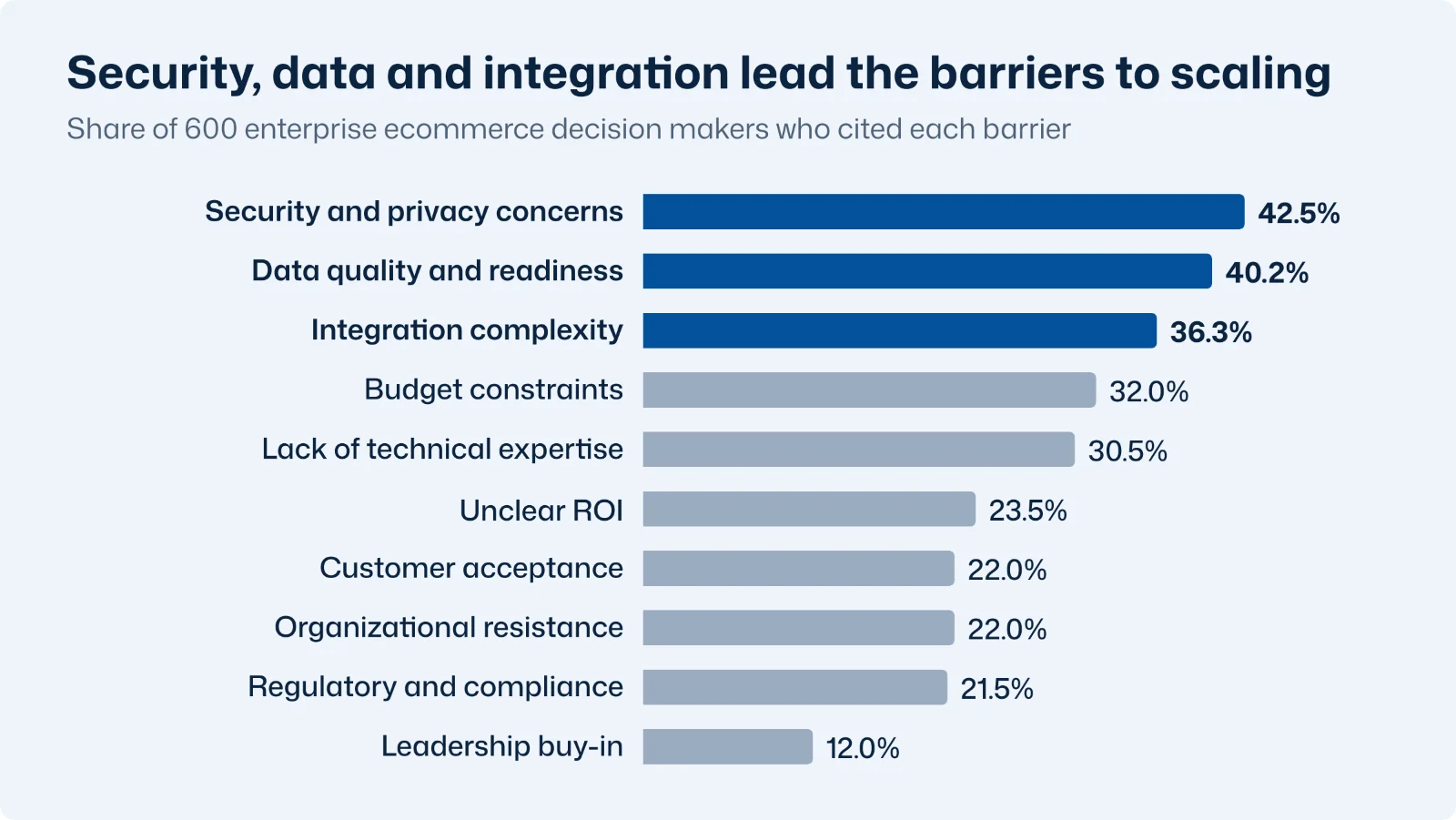
Figure 1. Share of 600 enterprise ecommerce decision makers who cited each barrier. Survey fielded November to December 2025. Source: Logicbroker and Midsail Research, The State of Agentic Commerce Adoption, 2026. [2]
HUMAN Security, which sells bot and agent security software, reported that 85.2% of the agent requests it observed in October 2026 went to product and search pages. Checkout and payment pages received 1.9%, although the volume of requests reaching those pages rose 117% from September. These figures come from applications HUMAN protects, and they count requests. HUMAN defines a request as one action, such as loading a page or running a search, so the figures don’t measure people, shopping sessions or completed orders. [5]
Source: HUMAN Security, State of Agentic Traffic, October 2026. Counts requests from applications HUMAN protects. [5]
One purchase can involve many product lookups and only a few checkout requests, so those percentages don’t tell us what share of orders agents place. They do give operators a reason to look at their own traffic now. An agent may be helping a customer choose a product well before it attempts a payment, and the merchant needs a deliberate policy for both activities.
Knowing which agent sent a request answers only part of the question. A merchant also needs to understand the authority behind the request and whether the proposed action fits its own rules. I’d use five questions to make that discussion concrete:
For example, a business customer might allow an agent to compare replacement parts and build a cart while requiring a manager to approve the purchase. Access to the customer’s contract pricing shouldn’t automatically grant permission to order. The merchant and its providers need a way to check the relevant authority before accepting the next action.
The Amazon and Perplexity dispute shows how customer delegation and site access can also come into conflict. On August 4, the Ninth Circuit vacated a preliminary injunction against Perplexity and returned the case to the district court. Its decision concerned statutory computer access on the facts before it, and left other questions unresolved. For merchants, the relevant distinction is between what a shopper asked an agent to do and what the merchant allows on its systems. [6]
Visa, BILL and Billtrust offer one example, in an October pilot that lets a recognized agent complete approved invoice payments for an identified buyer, using payment controls tied to the buyer’s instructions. Visa says participating businesses are processing live transactions. It’s a defined B2B payment flow, and merchants need to check whether their own platforms and providers can support comparable controls. [1]
Several other efforts address different parts of the problem, and the difference matters when you’re asking a provider what it supports.
A valid signature can help establish who sent a request, while permission and purchase checks answer other questions. Merchants can use supported controls now and plan for changes as standards develop. I’d ask providers to show what their current implementation does, including what happens when verification fails.
An assessment is easier to act on once you’ve chosen a job for the agent. You might begin with product search and a cart that the customer approves, or a recurring B2B order with agreed products and purchasing limits. That choice gives the team a specific path to examine and a manageable set of decisions.
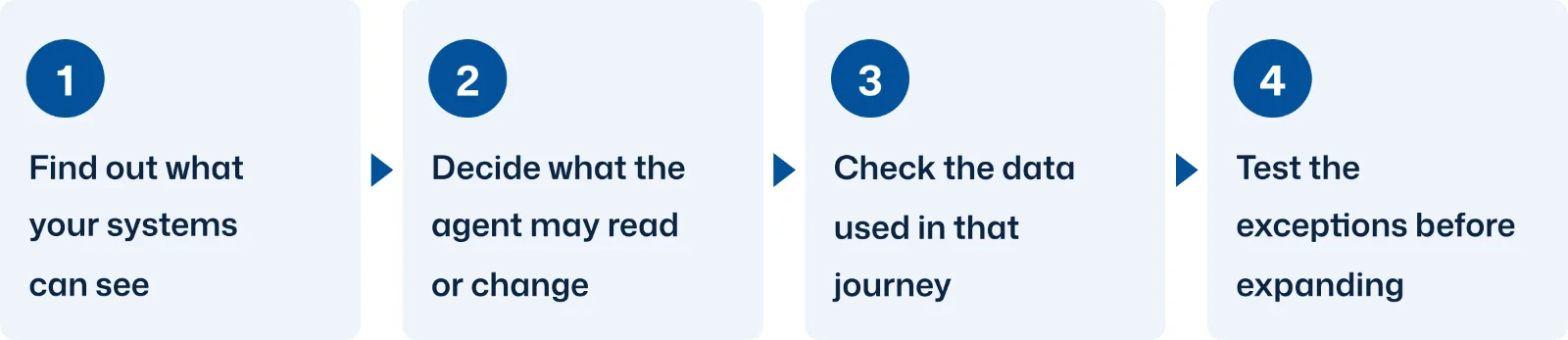
Ask the teams managing site security, analytics, commerce and payments to compare their records. What agent activity can they identify, what are they only inferring, and what remains unknown? Include blocked and failed attempts. A visit referred by an AI search tool is different from an agent operating the site, and the reporting should keep those measures separate.
Public browsing, viewing account prices, changing a cart, submitting an order and requesting a refund each need a decision. Specify the evidence required for each action, where the rule is enforced, and what happens when the evidence is missing or permission has expired. Where the platform supports it, a handoff to the customer can let a purchase continue with direct approval.
Start with product identifiers, variants and units of measure, then check price, stock, shipping costs and delivery dates. For B2B orders, include contract terms and approved delivery locations. If an agent orders a case of 12 and the order system treats that as one individual unit, the customer won’t receive what they expected. Test the information all the way through to the order the business receives.
Try a price change after approval, an item going out of stock, an expired permission and a repeated request after a timeout. Check that the retry doesn’t create a second order and that withdrawn permission stops future actions. Keep the pilot limited, give someone the authority to pause it, and record which failures need a person to resolve them.
I’d measure successful authorized purchases alongside failed legitimate attempts, data errors, duplicate orders and manual support work. Sales attributed to agents are useful to track, but a claim of added revenue needs a credible comparison with what would have happened without the change.
A good partner can turn those questions into a practical plan and help the merchant carry it out. The proposal should show which capabilities are already available, which need configuration or integration, and which gaps will remain. I’d want to see the following deliverables.
For a distributor, that might mean helping a customer’s agent reorder approved supplies at contract prices, with extra approval for substitutions or orders above an agreed limit. The partner would connect account permissions to the catalog and order system, then show how the process handles a changed price or unavailable item. The merchant would retain the decisions about acceptable purchases and customer treatment.
I’d also look closely at the handoff to customer service. AP2 describes records that can support a dispute, but leaves the details of dispute handling and record retention or retrieval outside the specification. Someone still has to connect the approval record to the order and make the relevant evidence available when a customer calls, and you can test that work by checking whether support staff can find the evidence during a call. [12]
Forrester’s Sandy Carielli has described bot and agent trust management as a shared concern for security, fraud, ecommerce, marketing and business leaders. The interests overlap, and the teams need to agree on policies that account for customer experience and revenue as well as abuse. [13]
I’d put a commerce or digital product leader in charge of coordinating the initiative. Security and identity teams should own verification and access controls, fraud and payments should own transaction acceptance, and data and operations teams should own the information the buying process relies on. Customer service and legal need to help settle how errors, disputes and exceptions will be handled.
The next step can be a working session with those people and your implementation partner. Choose one buying journey, agree on what the agent may do, and identify the proof and controls needed at each step. Leave with named owners and a testable pilot, so the business can start learning while the wider standards work continues.
Thank you to the Logicbroker team, to Midsail Research and to the 600 people who answered the survey. The full report has the rest of the findings. [2]
Sources checked November 18, 2026. Bracketed numbers refer to the corresponding entry below.
What business leaders need to know about showing up when AI does the searching
Read article
AI buzzwords are everywhere in SaaS marketing, but customers care about outcomes—here's how to shift your messaging from 'AI-powered' hype to real, tangible value
Read article
Chinese AI startup DeepSeek delivers GPT-4 level performance at 1/20th the cost, sending shockwaves through the tech industry and transforming AI accessibility.
Read articleAsk a CMO
Tell us what you are building, who needs to believe in it, and when you need them to.